

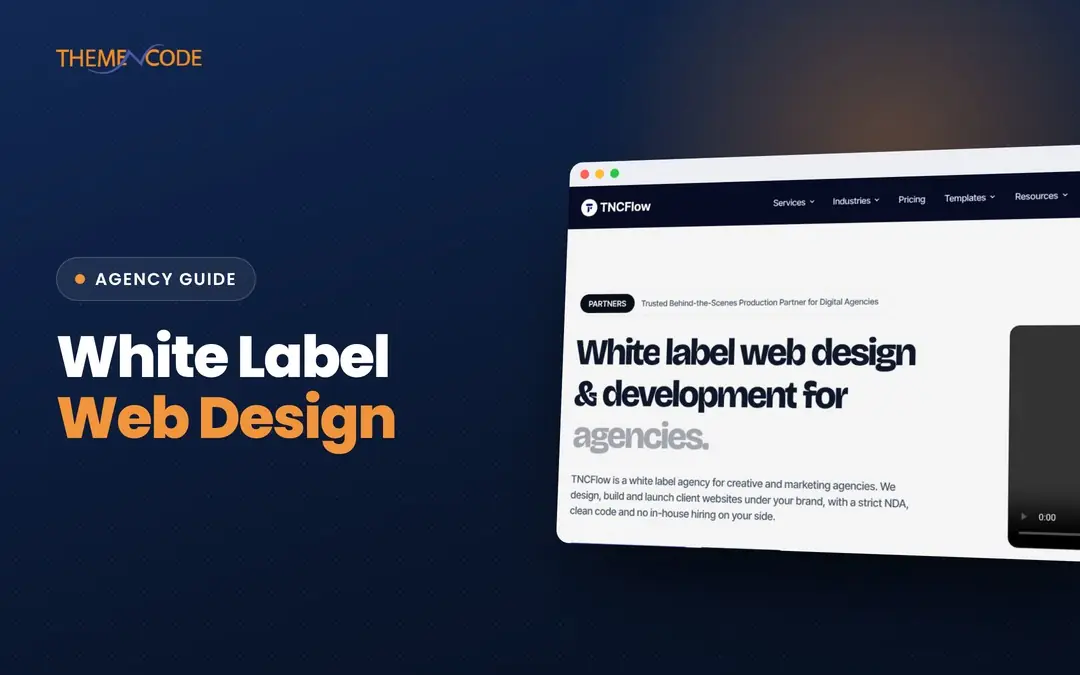
White label web design is when an agency sells websites under its own brand while a partner studio does some or all of the design and build work behind the scenes. The client only ever deals with the agency. The partner stays invisible, signs an NDA, and hands over finished work that the agency presents as its own.
For agencies, it is the fastest way to take on more projects without hiring a full in-house team. For marketers, consultants and freelancers, it is a way to add websites to a service menu without learning to build them. This guide explains how the model works, what it costs, how to pick a partner, and where it goes wrong.
In short: white label web design lets an agency resell websites built by a hidden partner. The agency owns the client relationship, strategy and pricing. The partner handles design and development under NDA. It works best when you have steady demand, a clear brief process and a partner whose quality you have checked on a paid test project.
How white label web design works
The model is simple on paper. The agency wins the project, gathers requirements, and sends a brief to the partner. The partner designs and builds, the agency reviews and presents, and the client signs off. Money flows the same way: the client pays the agency, and the agency pays the partner a wholesale rate.
In practice, the details of each handoff decide whether it runs smoothly. A typical project looks like this:
- Sales and discovery (agency). You scope the project, agree on budget and timeline, and collect content, brand assets and access details.
- Brief (agency to partner). You send a written brief: goals, sitemap, page list, references, brand guidelines, platform, integrations and deadline.
- Design (partner). The partner produces wireframes or a homepage design first, then inner pages once direction is approved.
- Review (agency). You check the work against the brief before the client sees anything. This step is where you protect your brand.
- Client presentation (agency). You present the design as your team’s work and collect feedback.
- Development and QA (partner). The partner builds on the agreed platform, tests across devices and fixes issues.
- Launch and handover (both). The site goes live on the client’s hosting or yours, with your branding on any documentation.
The partner usually works in your project management tool, uses a shared email alias on your domain if client contact is needed, and never mentions their own company to the end client.
White label vs outsourcing vs subcontracting
These terms overlap, and people use them loosely. The practical difference is who the client thinks did the work and who carries responsibility.
| Model | Who the client sees | Who owns the relationship | Typical use |
|---|---|---|---|
| White label | Your agency only | You | Ongoing overflow, full builds sold under your brand |
| Outsourcing (open) | Your agency, partner may be named | You | Specialist tasks like custom code or animation |
| Subcontracting | Sometimes both | Shared or defined by contract | Large projects split across firms |
| Referral | The partner directly | The partner | Work outside your focus, often for a fee |
Why agencies use white label partners
The main reason is capacity. Hiring a designer and a developer means salaries, onboarding, management time and the risk of paying people during slow months. A white label partner turns that fixed cost into a variable cost you pay per project.
- Scale without hiring. Take on a busy quarter without adding permanent headcount.
- Add services quickly. An SEO or ads agency can sell websites next month instead of next year.
- Access specialist skills. Webflow interactions, Framer, Astro, custom WordPress plugins or Shopify themes are hard to keep in house when you only need them a few times a year.
- Protect margins. You set the retail price. The gap between your price and the wholesale rate covers your sales, account management and profit.
- Focus on what you do best. Many agency owners are strongest at sales, strategy and client relationships. White label lets them stay there.
It is not a shortcut around quality, though. If the partner delivers weak work, it is your name on it. The agency still has to review, push back and own every outcome.
What white label web design costs
There is no standard price list, and anyone who quotes a single number without seeing your scope is guessing. Wholesale rates depend on a handful of factors:
- Scope. A five page brochure site and a 40 page site with a CMS, filters and integrations are different jobs.
- Platform. Template based builds on Webflow, Framer or WordPress cost less than fully custom code or headless setups.
- Design depth. Adapting a template is faster than original UI design with a full design system.
- Partner location and seniority. Rates vary widely by region and experience.
- Engagement model. Per project pricing, hourly billing, or a monthly retainer for a set amount of capacity.
As a rough guide, small template based sites often sit in the low thousands of US dollars wholesale, while custom designed marketing sites with a CMS commonly run from the mid thousands upward. Retainers for dedicated monthly capacity are usually priced by hours or by a defined output. Agencies typically mark up partner work enough to cover project management, revisions and risk, and the right markup depends on how much of the client handling you do yourself.
Per project vs retainer
| Pricing model | Best for | Watch out for |
|---|---|---|
| Fixed per project | Clear scope, one-off builds | Scope creep and change requests |
| Hourly | Small fixes, unclear scope | Unpredictable bills you must pass on |
| Monthly retainer | Steady flow of projects and edits | Paying for unused hours in slow months |
How to choose a white label partner
Most white label problems come from choosing a partner on price alone. Use this checklist before you send real client work:
- Review real portfolio work. Ask for live sites, not just mockups, and check them on a phone.
- Check platform fit. Make sure they build on the platforms your clients ask for, whether that is WordPress, Webflow, Framer, Shopify or Astro.
- Ask about process. How do they handle briefs, revisions, QA and handover? Who is your day-to-day contact?
- Confirm confidentiality. A signed NDA, no partner branding in code comments, footers or file names, and no direct client contact unless you approve it.
- Agree on ownership. Your contract should state that all design files, code and assets transfer to you (or your client) on payment.
- Test communication. Response times, time zone overlap and English level matter more than most agencies expect.
- Run a paid test project. One small, real project tells you more than any sales call.
If you want a partner that already works this way, TNCFlow offers a white label agency partnership covering design, Webflow, Framer, WordPress, Shopify and Astro builds, plus AI automation and growth work, all delivered under your brand.
Setting up a white label workflow that scales
Once you have a partner, the goal is to make every project feel the same. Repeatable process is what lets you grow from two projects a month to ten without chaos.
Standardize the brief
Create one brief template and use it every time. Include business goals, target audience, page list, content status, brand assets, competitor and reference sites, required integrations, platform, hosting, and hard deadlines. A clear brief prevents most revision rounds.
Define revision rounds and turnaround times
Agree on how many design revision rounds are included, how long each stage takes, and what counts as a change request. Put the same limits in your client contract so you are never promising more than your partner delivers.
Keep one source of truth
Use a shared project board, a shared folder for assets, and a single thread per project. Avoid scattering feedback across email, chat and calls. Write feedback as specific, numbered points with screenshots.
Own QA before the client sees anything
Check every page on desktop and mobile, test forms, look for placeholder text, confirm meta titles and descriptions, and run a speed test. Google’s SEO Starter Guide is a useful baseline for what a new site should have before launch.
Plan for after launch
Clients will ask for edits, new pages and maintenance. Decide in advance whether your partner handles ongoing work on a retainer, and price your own care plans accordingly. Recurring maintenance is often where white label relationships become most profitable.
Common mistakes to avoid
- Sending vague briefs. Thin briefs lead to off-target designs and extra revision cycles that eat your margin.
- Skipping your own review. Forwarding partner work straight to clients is the fastest way to lose trust.
- Overpromising timelines. Add buffer between the partner’s deadline and the client’s deadline.
- Ignoring ownership terms. Without a clear contract, you may not legally own the work you resold.
- Hiding the model in contracts. You do not have to name your partner, but your client contract should allow you to use subcontractors.
- Choosing on price alone. The cheapest partner often costs the most once you count revisions and lost clients.
Is white label web design right for your agency?
It tends to fit well if you have more demand than capacity, if websites are a supporting service rather than your core skill, or if clients regularly ask for platforms your team does not know. It fits less well if you sell mostly on the personal craft of named designers, or if you only get one website project a year.
A good way to start is small: pick one partner, run one paid project, refine your brief and review process, then expand. If you want to talk through whether a partnership makes sense for your pipeline, you can book a call with TNCFlow and walk through your current projects.
Frequently asked questions
What does white label mean in web design?
It means a partner designs and builds websites that your agency sells under its own brand. The client never sees the partner, and you own the relationship, pricing and final delivery.
Is it legal to white label websites?
Yes. It is a normal subcontracting arrangement. Make sure your client contract allows subcontractors and that your partner agreement transfers ownership of all work to you on payment.
How much should I mark up white label websites?
There is no fixed rule. Your markup should cover sales, project management, revisions, QA and risk, plus profit. Agencies that handle more of the client work themselves usually charge more.
Will my clients know I use a white label partner?
Not if the partner works under NDA, uses your branding and communication channels, and leaves no credits in the site code or files. Check this in your test project.
Can I white label website maintenance too?
Yes. Many partners offer monthly retainers for updates, backups, security and content edits, which you can resell as your own care plans.
How do I find a reliable white label web design partner?
Shortlist partners with live portfolio sites on your platforms, ask about their process and contracts, and run one paid test project before committing to more work.
If you are building a white label setup, it helps to see how an established partner structures it. TNCFlow’s services page shows the full range of work we take on for agencies.